How Much Attic Insulation Do You Need in Indiana?
If you live in Indiana, your attic gets to experience weather that would give most people a personality disorder. Freezing winters, humid summers, and temperature swings that make you wonder if the weather hates you. And your attic is sitting right in the middle of all of it.
So how much attic insulation do you actually need? The answer is usually discussed in R-value. R-value measures how well a material resists heat flow. As we all know higher numbers mean more resistance, but the number on a bag of insulation doesn't tell you how well the whole attic performs. Gaps, uneven depth, air leaks, and poorly insulated access hatches can all drag down the result. Indiana includes more than one climate zone, so the right target depends partly on where you live and what the existing attic looks like. For many homes, recommendations land somewhere around R-49 to R-60, but the applicable energy code and the home's specific conditions matter. The important thing is to measure what is there before deciding what to add. Guessing insulation depth from the attic hatch is a little like checking the gas tank by looking at the car.
More insulation isn't always the first move. Before adding insulation you must deal with the major air leaks between the house and attic. Common trouble spots include plumbing and wiring penetrations, open wall cavities, top plates, attic hatches, and gaps around ductwork. Those holes can let conditioned air move into the attic, carrying heat and moisture with it. Insulation slows heat flow. Air sealing controls air movement. They work together, but they're not doing the same job. Once the leaks are addressed, insulation should be installed evenly and to the intended depth. Don't bury unsafe heat-producing equipment or block required ventilation paths. The details matter, because an attic is a system, not just a big box that needs more fluff.
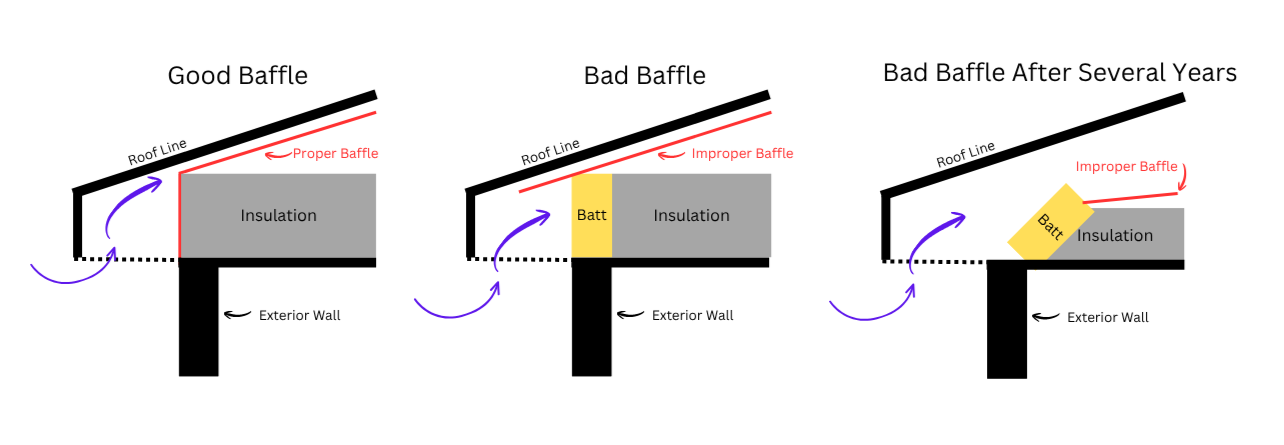
Good vs bad ventilation baffles
Another common failure point is the ventilation baffles. Usually the space between the baffle and the top plate is stuffed with fiberglass batts. Since the weather seems to hate us and gives us ultra high winds, those batts can blow out and blow out your cellulose around the perimeter of your that's a bad deal. When that happens we usually remove all of the insulation around the perimeter of your house so that we can get to root of the problem. Then we install new baffles properly, the way that they're meant to be installed.
So, do you need an attic insulation upgrade? If you can see the tops of the ceiling joists, the insulation is uneven, there's only a thin layer of old material, or you have a cold spot around the perimeter it's worth having the attic evaluated. High energy bills and uncomfortable rooms can be clues as well. The goal isn't to win the R-value Olympics. It's to build a continuous thermal layer, seal the holes that shouldn't be there, and make sure the attic can handle moisture properly. That's how you get an attic that actually performs, instead of one that merely looks insulated.